The Realness of Theatre
Theatre isn't content. It's people in a room doing something difficult together while other people watch. That's it. That's the whole thing.
You could probably train an AI to produce a community theatre musical. Script, blocking, lighting cues—all optimized. It could be technical perfection. It would be utterly lifeless. Theatre isn't content. It's people in a room doing something difficult together while other people watch. That's it. That's the whole thing. Showing up is eighty percent of the battle.
One the most fun shows I ever took part in was VOS theatre's Spamalot in 2013. It was directed by Bea Quarrie - the first musical I was in that she had directed (the first being Vimy in 2011, a play by Canadian Verne Thiessen). She brought a ton of innovative thinking to the production - she was always thinking up ways to bring new life to lines that seemed to have been over and over, making them seem new again. She and her production team, led by Liz Clark, decided that nobody was going to say "NO" to anything before considering whether it would work. I thought that in itself was innovative thinking for a team.

It seemed to me that, with that kind of thinking, it was impossible NOT to succeed.
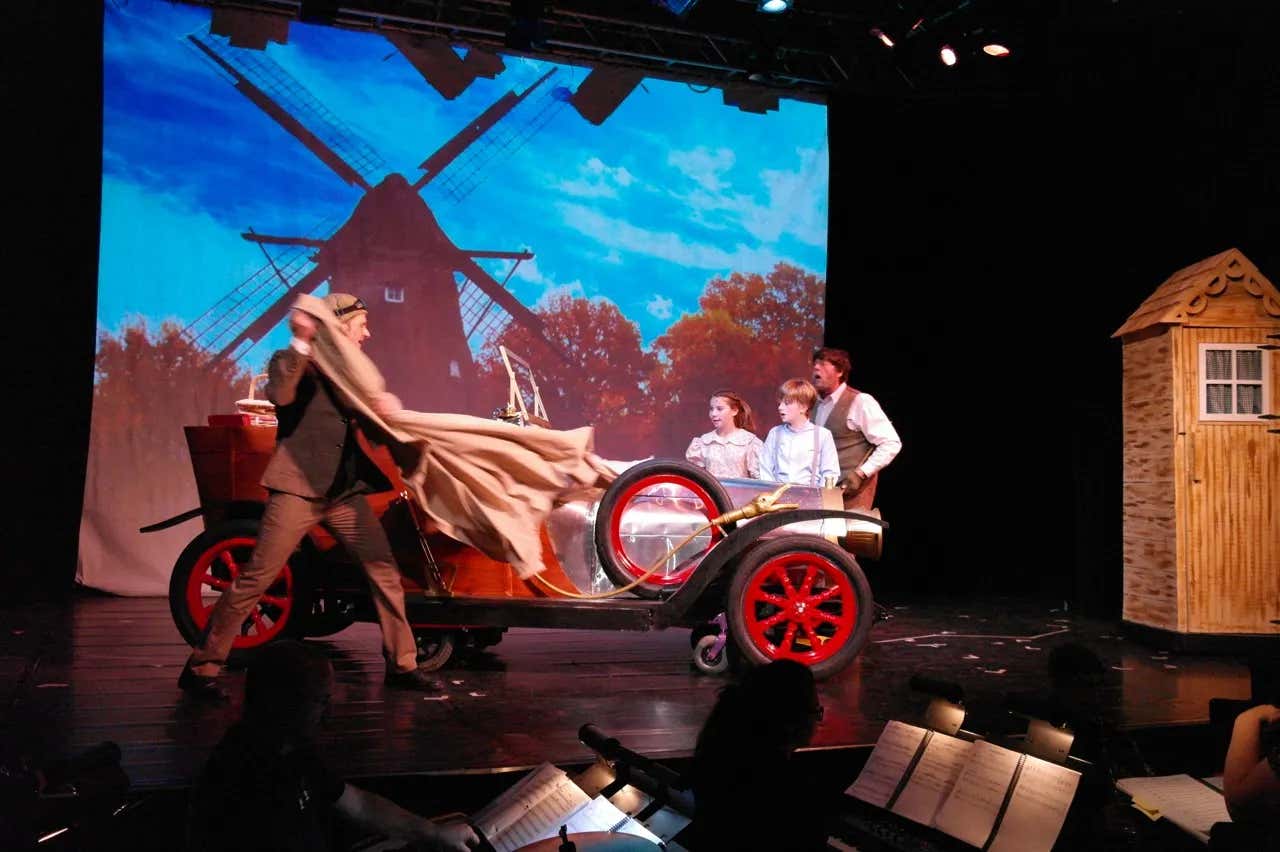
It was the first show to introduce background projections instead of a painted backdrop. Victoria Hall as a venue is super cramped, with no capability to fly in different pieces. The projections opened up a new set of possibilities. As an actor I never even saw much of them, but the audience seemed to love it. The projections were like a whole other character.
VOS immediately bought their own projector to continue the practice. We shaped our sets around the projections, as a director I adjusted the blocking. We got more and more adept, as did other companies, around using projections to take the audience into a particular scene. There's a whole sub-market that's evolved selling projection kits to community theatres. Instant scenery - just download the slides.
I have to admit, I've become a little uncomfortable with background projections. Sometimes they work beautifully, and sometimes they are cringy. I'm really proud of the work Marc Mireault did on many of our shows (especially Young Frankenstein), and I think the projections we created for Anne of Green Gables were stunning. In other cases I think they can become a crutch that too much of the show was built around.


My time at VOS allowed me to dig deep into a lot of the technical aspects of theatre. That same production of Vimy that Bea Quarrie directed also brought Todd Charlton into our lives. He was an excellent sound designer and even better human being. He showed me how a soundscape can completely transform a production - bringing an audience deeper into the story. He hand-crafted the sound of our Chitty-Chitty-Bang-Bang car with a composite of over a hundred sounds all pieced together.
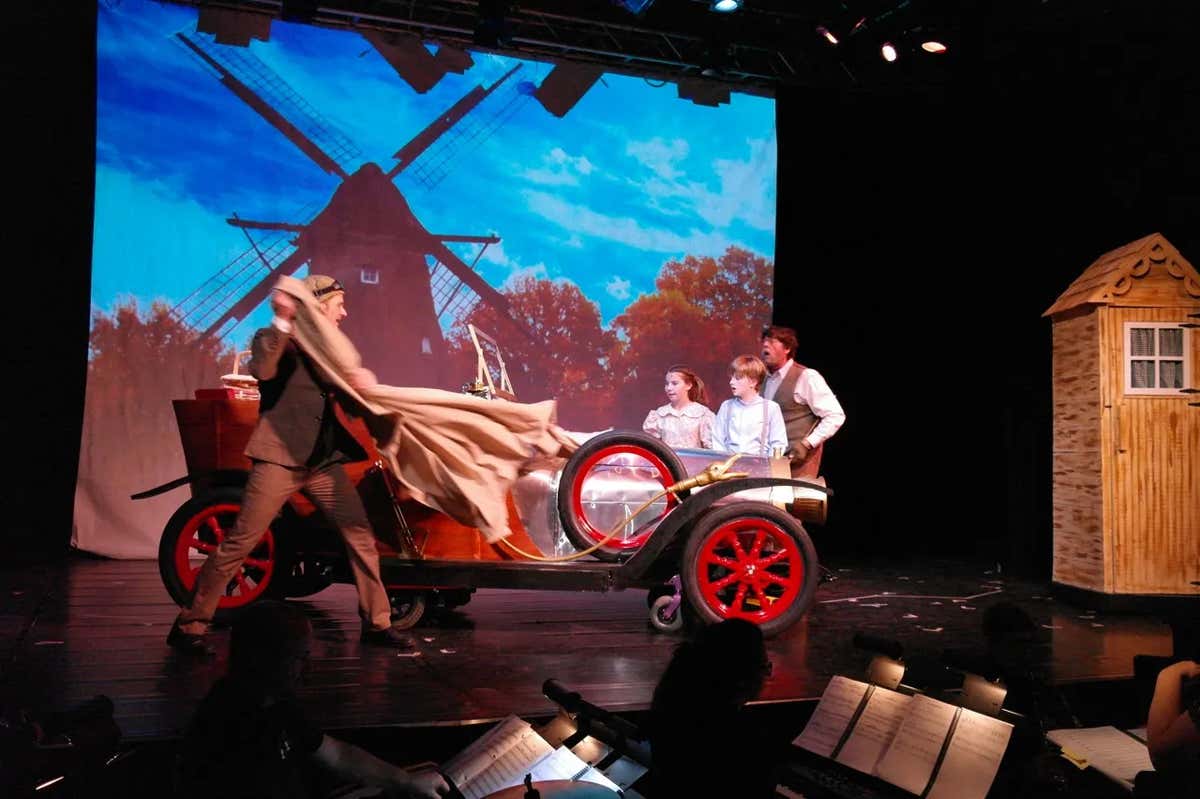
I remember on the weekend of move-in for Chitty, everyone else had gone home, and there I was - the director - laying on my back under the stage trying to get my homegrown fog machine to work properly. Todd stuck his head under and said to me "what the heck are you doing under there?"
"Trying to make magic," I replied. "Out of a cooler of ice and some fans and Froggy's Fog Juice."
"I get it," he said. "That's why I keep coming back here. Listen to this..."
When he passed away suddenly a couple years later it left a huge gap in my heart. I never really understood why - I didn't know him that well, only through shows - but now, coming back to theatre after an extended period, I'm starting to realize.
On a backstage tour of the Shaw Festival Theatre, I kicked at a piece of equipment on the floor. It looked like something my dad would have welded up to hold an air compressor. It was a rectangular prism shape, and it did have a compressed air tank in the middle, and 4 heavy duty casters. When I asked the tour guide about it, he smiled and pressed a little button on the side of the contraption. A tiny hiss sound came out and the wheels retracted, leaving the whole thing sitting on the steel square tubing.
"It's how we can bring on set of stairs," he said, "and have a whole cast of actors clambering up and down them without a care in the world. Take a look when you watch the show tonight to see if you can spot all the times we use these things."
Fast forward a few years, and VOS had bought 3 sets of what we referred to as "the pneumatics." We moved a house, stairs, a gymnasium, a bridge, you name it. Alan Fletcher, Scott Berry, Steve Koomen, and the rest of the crew created the most insane stuff that could be moved on and off the stage to fit into a four-by-twelve section of the wings.


That's why theatre, and the people who create it, leave a hole in your heart when they're gone.
You build real things together. You take an audience on a journey. You tear down walls between each other. You feel things that we normally drown out with the white noise of daily life.
When it's over, you take it down, take it apart. Say goodbye.
What are we doing next?
Look at that - what started out as a post about how we need to be careful about using digital projections in theatre ended up talking about connecting with each other.
One thing is clear: our lives have become far too virtual. We meet virtually; we work virtually; we watch content that's fake AI slop or computer generated special effects.
You can't fake theatre. You have to show up to see the show.
I promise you it's gonna be magic.

Mamma Mia is presented by Northumberland Players and runs February 20 to March 1st at the Capitol Theatre in Port Hope, Ontario. For tickets visit https://northumberlandplayers.ca/whats-on/2025-2026-season/mamma-mia/.